
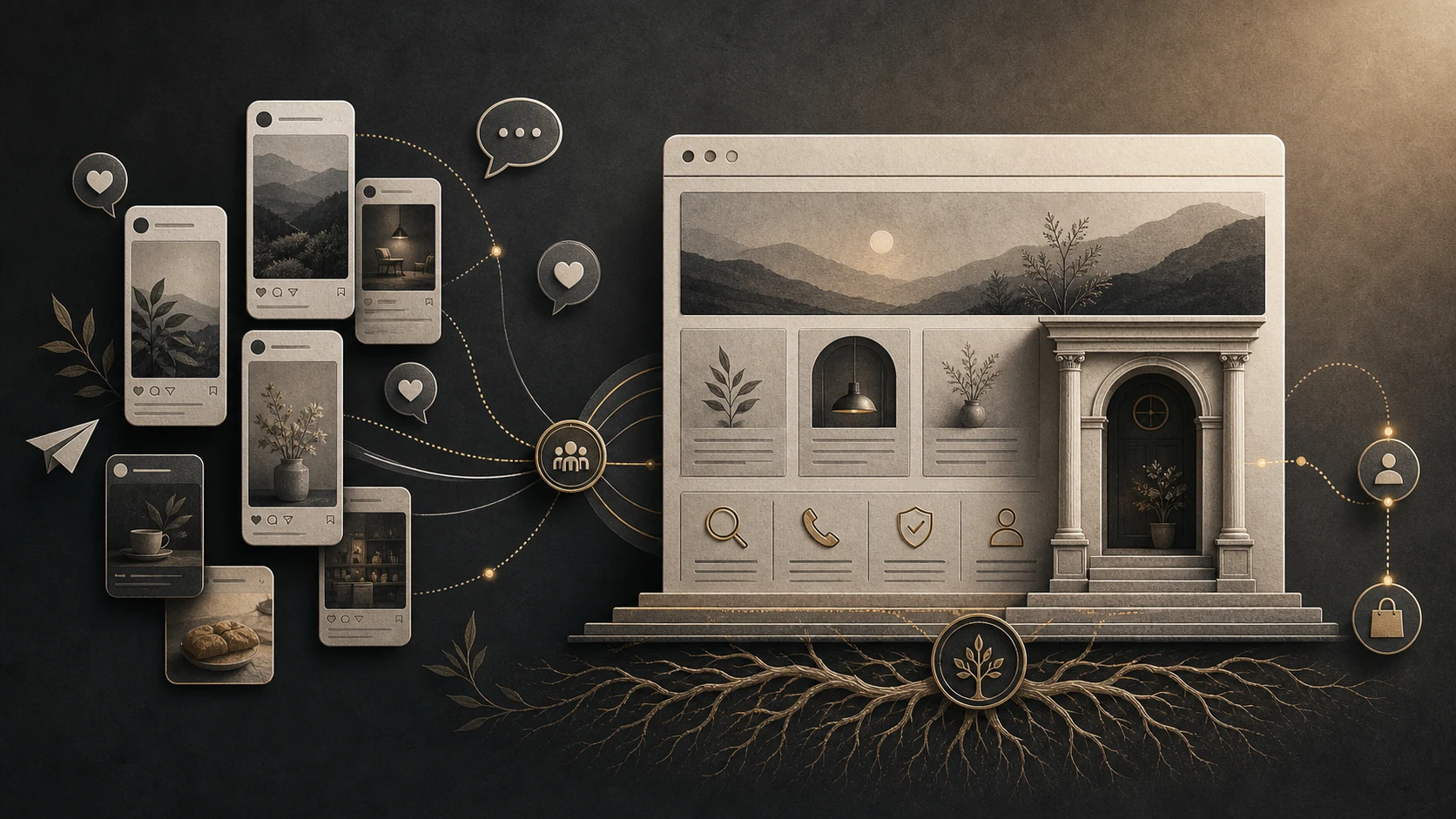
So, do you need a website if social media is already working? Usually yes—but perhaps not for the reasons you expect, and not necessarily in the form of a large, expensive website.
A small business can build genuine visibility, community and even sales through social media. For some people, a Facebook Page, Instagram account or LinkedIn presence is where customers already are and where the first useful conversations happen.
That does not make a website obsolete. It means the website and social channels should be judged by the different jobs they perform.
Social media is excellent for discovery, immediacy and interaction. A website gives the business a stable place to explain itself, organise information, appear in search, support customer journeys and connect the systems that sit behind the public-facing activity.
When can social media be enough?
A social-only presence can be a reasonable starting point when you are testing an idea, running a short-term project, selling a small range through an established marketplace or relying mainly on direct referrals.
It can also suit a very visual business whose customers genuinely prefer to enquire through messages. If the account is active, information is current and the owner can keep up with conversations, it may perform better than a neglected website.
The Australian Government’s guidance describes social media as an affordable way to promote a business, interact with customers, build loyalty, sell and direct traffic to a website. It also recommends choosing platforms according to where the target customers actually are rather than joining everything available. The business.gov.au social-media guide is a useful overview.
So the case for a website should not begin by pretending social media does not work. It should begin by asking what becomes difficult when social media is the whole system.
If social media is currently bringing suitable customers and you can manage the enquiries well, do not replace it for the sake of having a website. Add a website when it can provide something useful that the social account cannot.
Social platforms are valuable—but they are not your premises
A social profile exists inside somebody else’s product. The provider decides how profiles are displayed, which features remain available, how much unpaid content is shown and what behaviour is permitted.
This is not an argument for panic. Businesses use third-party services every day. It is simply a reason not to place every important asset and customer pathway in one external account.
Platform terms also allow accounts or content to be restricted in certain circumstances. Meta’s terms describe conditions under which access may be suspended or disabled, while LinkedIn’s user agreement reserves similar powers for misuse or breaches. Meta Terms and the LinkedIn User Agreement provide the current wording.
A website does not make the business invulnerable. It still depends on a domain, hosting, software and maintenance. The difference is that these components can usually be moved or replaced while preserving the core content and customer experience.
What does a website add?
A controlled explanation of the business
Social profiles are designed around feeds. Important information competes with recent posts, platform navigation and advertising.
A website lets you decide what a prospective customer sees first. Services can be grouped clearly. Project examples can include context. Frequently asked questions can sit beside the relevant offer. Contact options can reflect the way the business actually works.
This becomes more important when the work is complex, valuable or trust-dependent. A customer choosing a web developer, photographer, consultant, builder or care provider may want more evidence than a grid of recent posts can comfortably provide.
Information that remains findable
A useful social post may attract attention for a few days and then become difficult to locate. Website pages and articles can be organised, linked and updated over time.
They can also be discovered through search. Google’s current SEO guide describes search optimisation as helping search engines understand content and helping people decide whether to visit a site. It emphasises clear organisation, descriptive titles, useful original content and relevant links rather than secret ranking tricks. Google’s SEO Starter Guide is refreshingly direct on this point.
A website does not automatically produce search traffic. It creates the opportunity to publish information that can be understood, linked to and found beyond the lifetime of a social post.
Clear customer pathways
Social messages are convenient until important details are scattered across several conversations. A website can guide the next step more deliberately.
A visitor might choose a service, complete an appropriate enquiry form, book a consultation, pay a deposit, join a mailing list or open a support ticket. The information can reach the correct person or system without relying on somebody noticing a message request.
That is where a website begins to become more than a brochure. It can support communication, customer relationships, bookings and sales as the business needs them. Your Website Should Be More Than a Brochure explores that broader role.
A connection between marketing channels
Your website can act as the source for articles, project stories and resources, while social media distributes smaller versions and starts conversations. Email can continue the relationship with people who have deliberately subscribed.
The result is not a choice between website and social. It is a system in which each channel does the job it handles best. How Your WordPress Website and Social Media Can Work Together provides a practical publishing workflow.
Social media can be the busy front gate. Your website is the place where people can come inside, understand the business and take the next step.
Signs that social-only is becoming limiting
You may be ready for a website when:
- you repeatedly type the same explanation into direct messages;
- customers struggle to understand the difference between services;
- important information is buried in old posts or story highlights;
- you need better enquiries, bookings, deposits or support requests;
- the purchase requires substantial trust or comparison;
- you want articles or resources to remain findable;
- you are building an email list or customer-management process;
- advertising needs a focused landing page;
- partners, media or larger clients expect a clear business presence;
- one social account has become a single point of failure.
Any one item may be enough. The website earns its cost when it improves a real part of the business, not when it exists only to satisfy a checklist.
A useful first website can be small
The answer to “Do I need a website?” is not automatically “Yes, and it needs fifteen pages.”
A credible first version might contain:
- A focused homepage explaining what the business does, who it helps and why someone should trust it.
- Clear service or product information with enough detail to support a decision.
- Evidence such as project examples, testimonials, qualifications or a transparent description of the process.
- Answers to important questions about location, timing, suitability, pricing approach or what happens next.
- A useful contact path that gathers the information needed to respond well.
- Basic legal and privacy information appropriate to the data being collected.
That foundation can grow. Articles can be added when there is something useful to say. Booking can be introduced when scheduling becomes a burden. CRM or mailing-list integration can follow when there is a genuine communication plan.
Starting small is often safer than building a complicated system around guesses.
What about businesses whose customers live on Instagram or Facebook?
Keep using the platform. A website does not require you to drag every interaction elsewhere.
The practical approach might be to maintain an active social presence while linking to a small website for the things social handles poorly: detailed service information, permanent project examples, terms, booking, email signup or a structured enquiry.
Some customers may continue to message. Others will prefer to read first and contact later. The website gives them that choice.
What if nobody visits the website?
A website needs distribution. Include it in social profiles, email signatures, proposals, directories, invoices and printed material. Link individual social posts to relevant pages when the deeper information genuinely helps.
Search visibility develops gradually and depends on the market, competition and usefulness of the content. The first measure of success may not be huge traffic. It may be fewer unsuitable enquiries, more prepared customers or one page that answers a question you previously explained every week.
A website can be valuable with a modest audience if it helps the right people make better decisions.
A website is probably worth considering if you can name one important job for it:
- explain something social media handles badly;
- build trust before a high-value decision;
- capture better enquiries;
- support bookings, payments or ongoing clients;
- publish information people need to find again;
- reduce dependence on one external platform.
Is a website too expensive?
It can be, particularly when a small business is sold a large project before the purpose is clear.
Compare the cost with the work the website will perform. If it saves several hours each month, improves the quality of enquiries, supports sales or prevents customer confusion, the calculation is different from paying for an online ornament.
The first version can concentrate on the highest-value job. Additional capability can be added when the business is ready and the need is proven.
Is maintenance another burden?
Yes, a website requires maintenance. Software needs updates, forms need testing, backups need checking and old information needs correction.
Social profiles require maintenance too: regular activity, replies, moderation, security and adaptation to platform changes.
The sensible answer is not to pretend either channel runs itself. It is to choose a manageable setup, assign responsibility and avoid unnecessary complexity. A small, well-maintained website is preferable to a sprawling one nobody understands.
So, do you still need a website?
If social media is working, keep using it. It is already demonstrating where your customers are and what they respond to.
A website becomes useful when the business needs a stable home for information, stronger trust, search visibility, better customer pathways or connections between marketing and operational tools.
You may not need a large website immediately. You may need one well-designed place that explains the business properly, belongs to your broader system and can grow when the next useful job becomes clear.
Social media can open the conversation. The website can help the customer understand, decide and act.
Start with the website your business actually needs.
Grey Lily Media can help identify the smallest useful starting point and build a WordPress site that can grow with the business.
Keep reading

Every Website Form Should Have One Job
A practical way to decide what a website form should ask, where its answers should go and how it can reduce work for customers and the business.
Read article →
Your Website Isn’t Broken. Your Business Model Is.
Website problems often begin with unresolved decisions about services, pricing, capacity, policies and customer fit. Use your website project to find and fix the right problem.
Read article →
Simplicity Is Expensive to Create: Why Clear Websites Take More Work
A simple website is not the absence of information. It is the result of clear decisions about services, prices, pathways and responsibilities. Here is the work that makes simplicity possible.
Read article →